
Healthy, responsive voice
Breath, resonance, range, agility and dynamics developed without pushing or shouting over tracks.
Hindustani + film music · Live online 1:1
Love Bollywood? Build the voice behind it.
Build sur, taal, range, breath and ornamentation, then apply them directly to Bollywood songs across romantic, semi-classical, Sufi, folk, retro and contemporary styles.
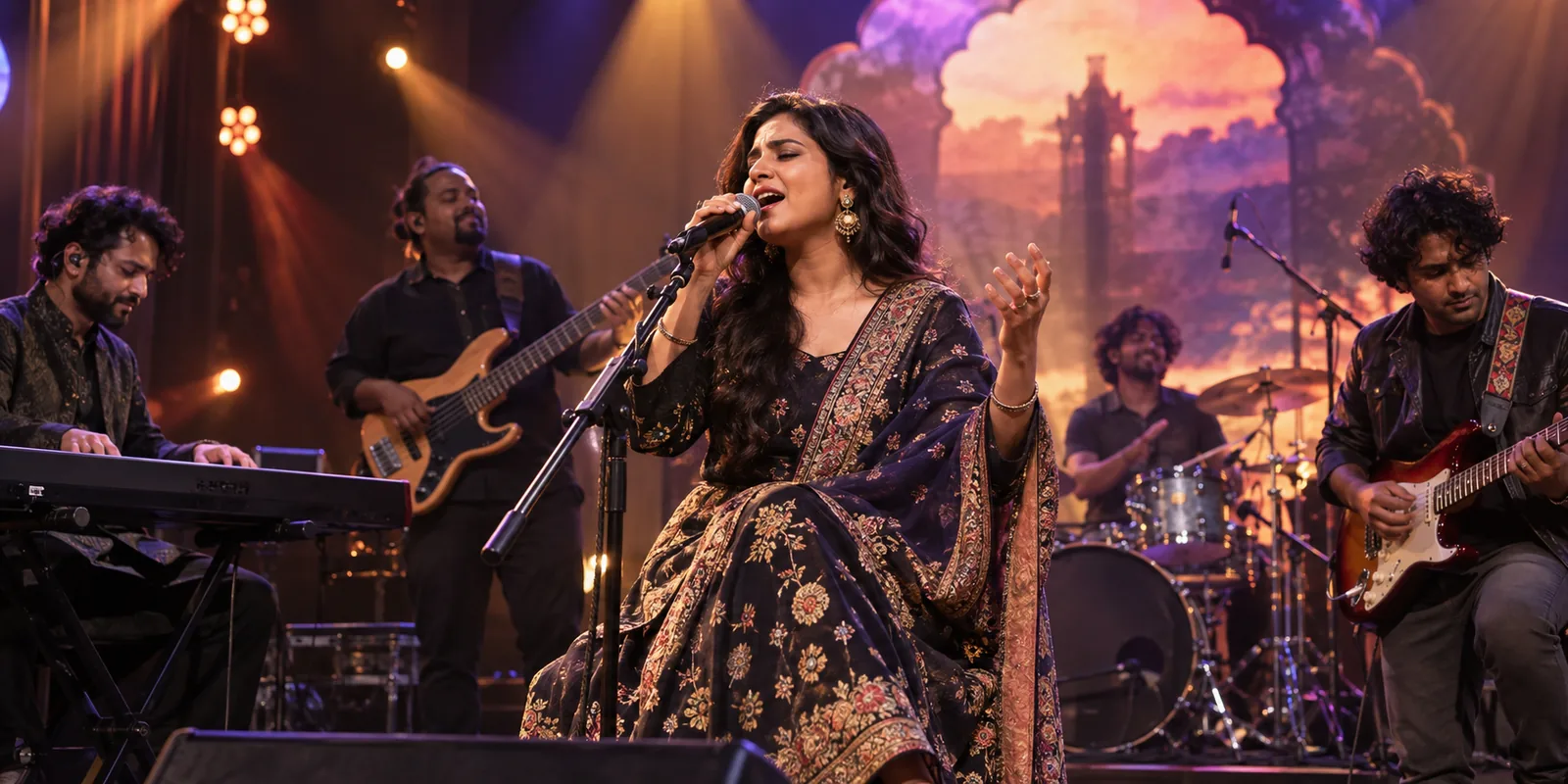
A classical-to-film pathway
This is neither a reduced Khayal syllabus nor karaoke imitation. Every song becomes a vehicle for transferable voice, rhythm, diction and interpretation skills.
Breath, resonance, range, agility and dynamics developed without pushing or shouting over tracks.
Tanpura alignment, swara accuracy, pulse and confident entries through changing arrangements.
Meend, murki, khatka, gamak, taan and raga awareness used with stylistic judgement.
The film-song difference
Learn melody, rhythm and words cleanly first. Then shape tone, dynamics and emotion in your own voice without copying the original singer.
Language pathways
Pronunciation, meaning and natural speech flow are taught alongside melody. Transliteration can support learning, but it does not replace language-aware coaching.
The primary pathway across eras, semi-classical, Sufi, folk, retro and contemporary film music.
Bengali film songs and selected modern repertoire with a suitably language-fluent trainer.
Marathi film songs, suitable Bhavgeet-influenced material and contemporary repertoire.
More than one language
Bengali or Marathi repertoire can grow gradually when suitable trainer support is available. Difficult lyric-dense songs wait until pronunciation guidance is strong enough.
Three-stage curriculum
Songs are chosen for range, breath, language, rhythm, ornamentation, age and current goals, not popularity alone.
Beginner
Start with healthy vocal habits and connect every technical exercise to film songs from the beginning.
Simple Bollywood melodies, gentle romantic and devotional songs, retro and folk-influenced material, plus suitable Bengali or Marathi songs with language-matched guidance.
What you will learn
Maintain Sa more reliably, sing simple swara patterns in rhythm, use clearer diction, reproduce short phrases by ear and complete selected songs with a track.
Progress depends on stable sur, basic rhythm, healthy voice use, clear words and growing independence through a complete song, not the number of songs memorised.
Placement by ability
The trial considers sur, range, breath, taal, ear, diction, phrase retention, previous training, ornamentation, track confidence, repertoire control and goals. Returning learners keep the skills they can demonstrate.
How you will learn
Detailed diction, ornamentation, song choice and microphone work benefit from individual correction, so this course is taught one-to-one.
Your exercises, key, repertoire and pace are shaped around your voice, chosen language and goals.
The SURIX Film Song Learning Method
Practice reconnects warm-up, Sa alignment, one technical phrase, lyric work, track rehearsal, a complete run and one specific recording goal.
Identify the tonic, structure, tempo, mood and difficult sections.
Work through pronunciation, meaning and natural speech flow.
Secure pitch and rhythm before adding stylistic detail.
Mark breath, meend, murki, taan, dynamics and register changes.
Practise exercises that directly support the current challenge.
Refine entries, interludes, microphone distance and continuity.
Listen back for specific sur, taal, diction and expression issues.
Shape the accurate song in your own voice without distorting it.
Kids + teenagers
Age-appropriate lyrics, comfortable ranges and shorter exercises build a serious foundation without detaching training from film repertoire.
Adults + returning singers
Start from scratch or build on previous Hindustani and film-song experience. Placement respects what your voice can demonstrate today.
Student stories
Reflections on learning difficult phrases, clearer language and a repertoire that stays personal.
“I finally know what to practise when a Bollywood line feels difficult.”
Earlier I would just replay the original song and keep singing the same line. My trainer now breaks it into swaras, breath and meend first. I learn the song faster, and I can actually hear what was going wrong.
“The Hindi pronunciation work changed the whole song.”
My daughter could sing the tune, but some of the words were not clear. Her teacher works on the lyric before expression, and now she sounds much more natural instead of just copying what she hears from the recording.
“I wanted Marathi songs without giving up my Bollywood repertoire.”
Hindi is still my main focus, but my trainer also helps me with Marathi songs that suit my range. The language corrections are very specific, and the Hindustani exercises connect well to both.
Frequently asked questions
Clear answers about languages, classical foundations, repertoire, recording and progression.
Your film-singing journey can start here
Learn the melody. Understand the words. Refine the technique. Sound like yourself.