
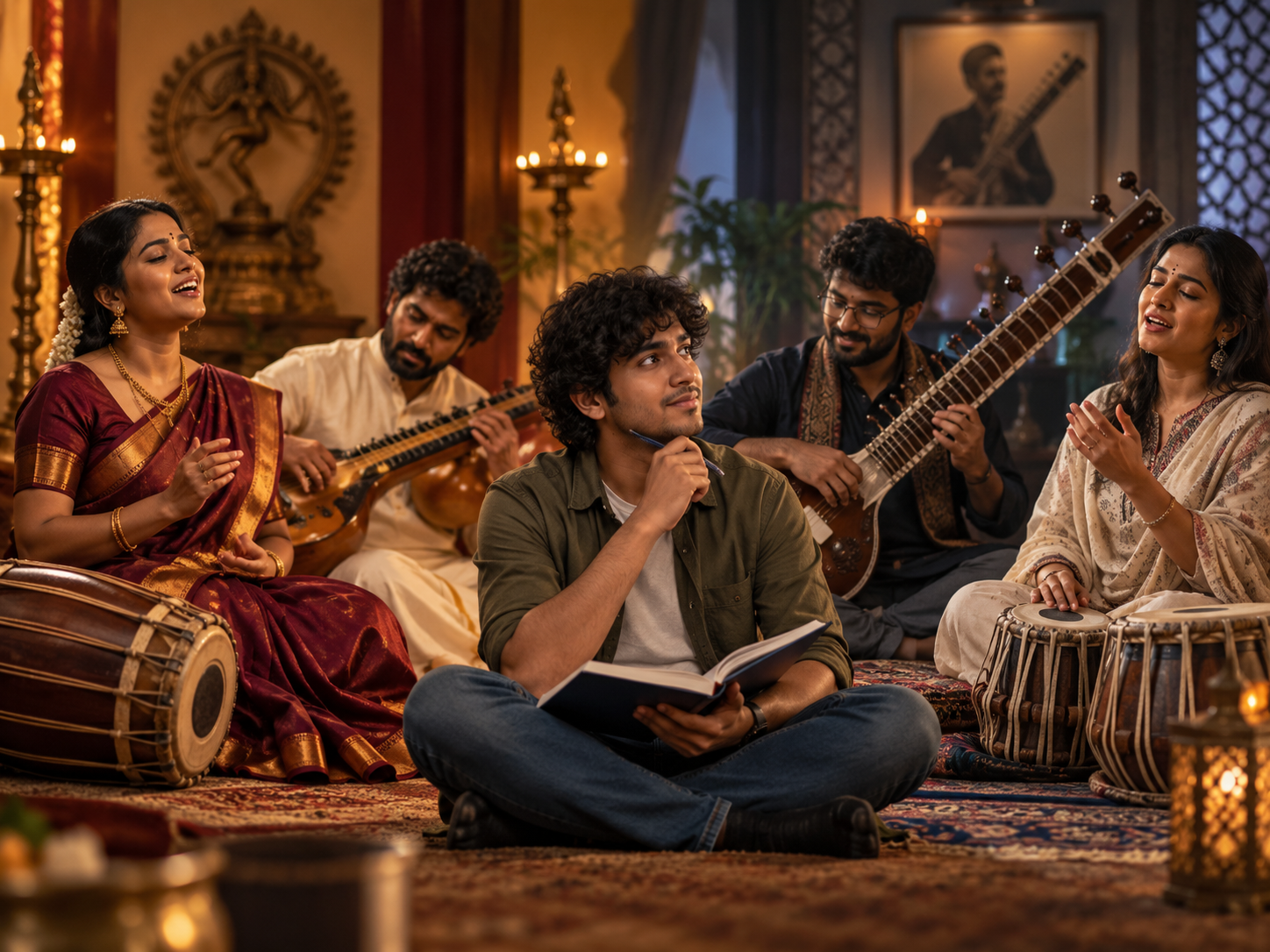
Every December, something magical happens in India.
In Chennai, the Margazhi season takes over. Sabhas are packed, filter coffee is flowing, and you will find a 70-year-old paati and a 19-year-old college student sitting in the same row, both nodding to the same kriti.
Around the same time, over a thousand kilometres away in Pune, the Sawai Gandharva Bhimsen Mahotsav is in full swing. People stay up past midnight wrapped in shawls, waiting for a single alaap to unfold slowly, like sunrise.
Two cities. Two festivals. Two completely different sounds. And yet, both are Indian classical music.
So if you have decided you want to learn classical music, you have probably already hit the big question: Carnatic or Hindustani?
Ask your relatives and you will get strong opinions. Ask the internet and you will get a history lecture. Let us do this differently. By the end of this guide, you will know what separates the two and, more importantly, which one fits you.
The difference at a glance
Overall sound
Core focus
Learning feel
Concert arc
01 / Origins
First, the plot twist: they were once the same
Carnatic and Hindustani music were not always rivals. They were siblings raised in the same house.
Both trace their roots back to the Samaveda and ancient texts such as Bharata's Natya Shastra. Even as late as the 13th century, Sarngadeva's Sangita Ratnakara was studied by musicians across the subcontinent and is often seen as the last major text the two traditions share.
Then history stepped in.
In the north, centuries of Persian and Central Asian influence through the courts of the Delhi Sultanate and the Mughals shaped a style that valued improvisation, mood and patronage-driven performance. This became Hindustani music.
In the south, the tradition stayed closely tied to temples, devotion and composition. Purandara Dasa, often called the father of Carnatic music, built a teaching system students still use today. Later, the Trinity of Tyagaraja, Muthuswami Dikshitar and Syama Sastri created a treasure chest of songs that became the backbone of Carnatic music.
Same parents. Different upbringing. Very different personalities.
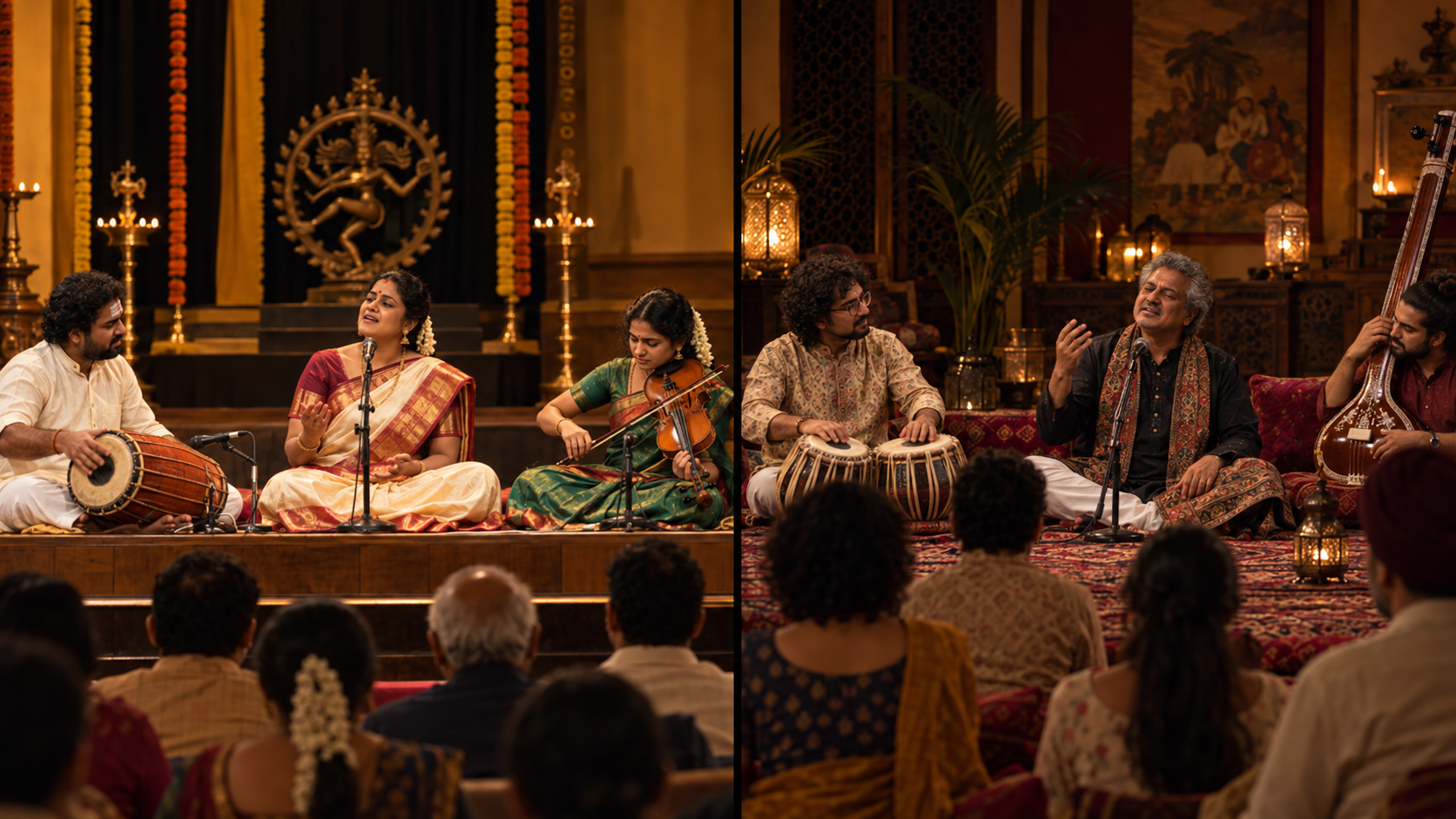
A Carnatic kutcheri and a Hindustani mehfil reveal two distinct performance cultures rooted in the same classical tradition.
02 / Comparison
Carnatic vs Hindustani music: the real differences
1. The vibe
Hindustani music is like a slow-cooked biryani. It starts with a long, unhurried alaap, where the artist explores the raga note by note with no rhythm at all. The tempo builds gradually, and the final section can become fast and electrifying. Patience is part of the experience.
Carnatic music is more like a full South Indian meals spread: lots of variety in one sitting, structured, with rhythm present early on. A typical concert moves through many compositions, each with its own raga and mood.
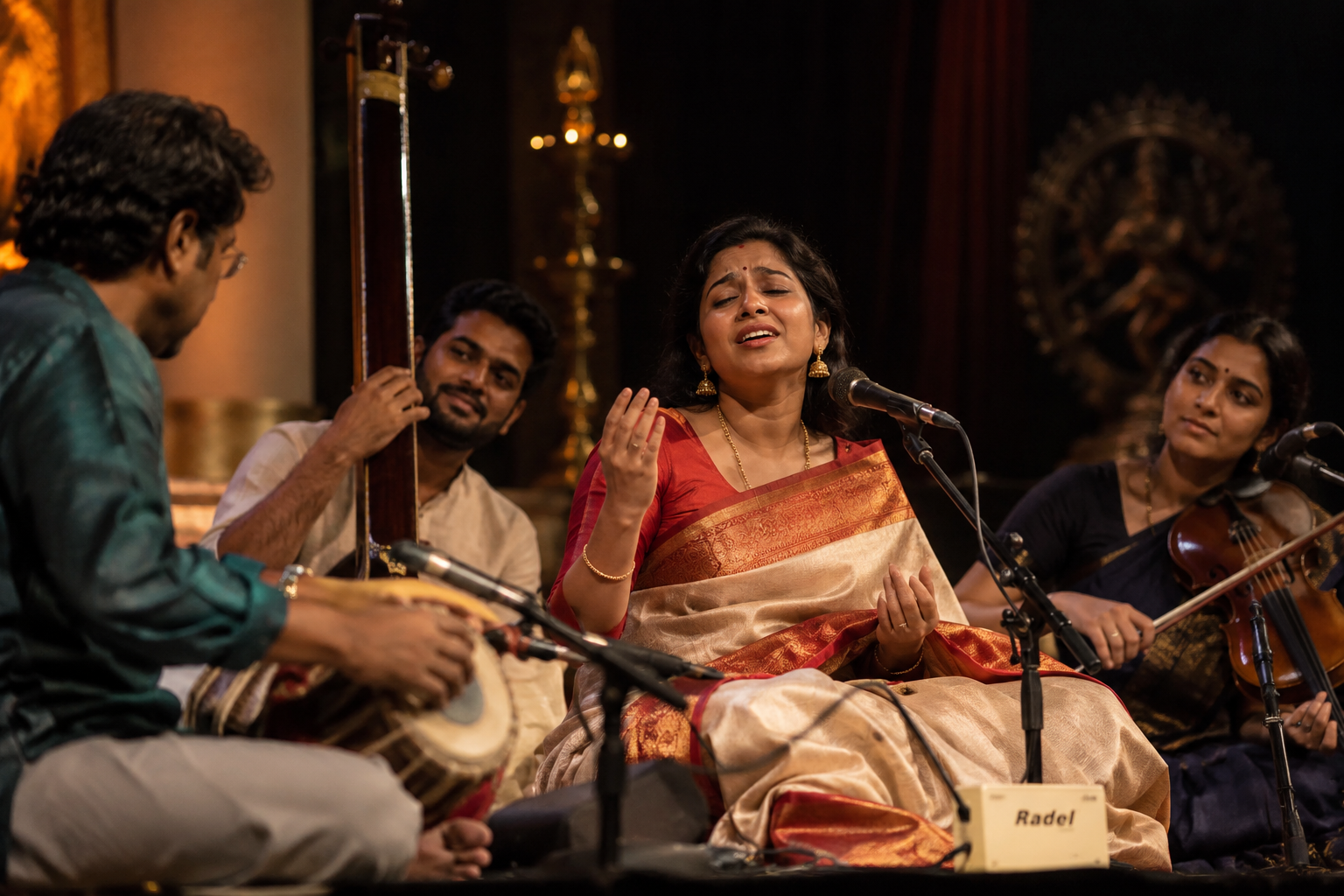
Gesture, breath and attentive listening turn each phrase into a live conversation.
2. Composition vs improvisation
Carnatic is composition-centred. Most of the concert is built around fixed songs, including kritis, varnams and keerthanams. Improvisation through alapana, niraval and kalpanaswaram happens around the composition.
Hindustani is improvisation-centred. The composition, called a bandish, is usually short and acts as a launchpad. The artist's own exploration of the raga is the main event.
3. How ragas are organised
Carnatic music uses the 72 Melakarta system, a mathematical framework where every parent raga is mapped logically. Hindustani music mostly follows the 10 Thaat system, organised by Pandit Vishnu Narayan Bhatkhande in the early 20th century.
The same scale can have different names across the two. Carnatic's Shankarabharanam is structurally close to Hindustani's Bilawal: the same notes, with different personality and ornamentation.
4. Gamakas vs meend
Carnatic music is famous for its gamakas, the oscillations and shakes around a note. Hindustani music leans more on meend, smooth glides between notes, and a steadier hold on individual swaras. Neither is better; they simply feel different in your throat and fingers.
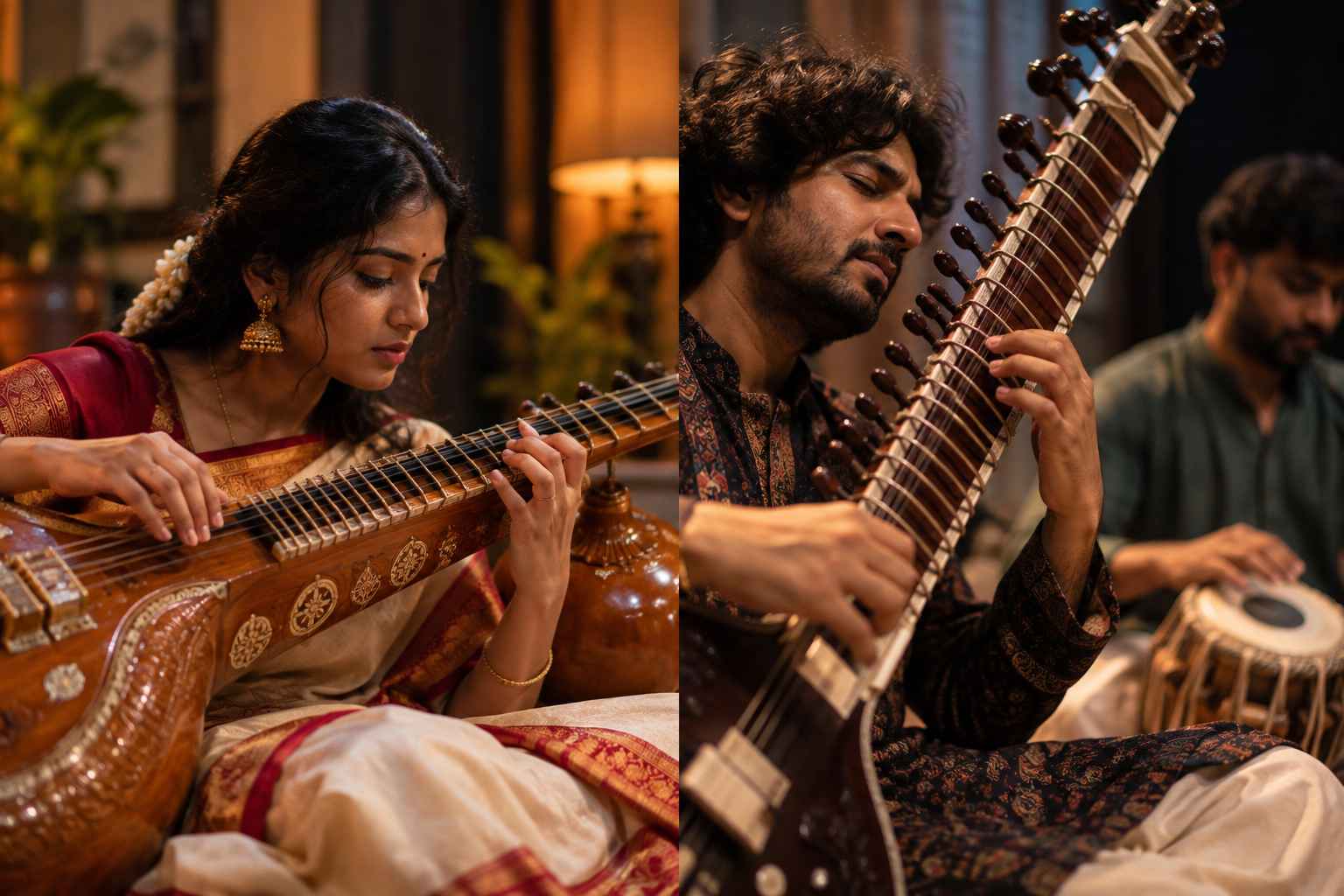
Close-up string work shows how ornamentation gives each tradition its unmistakable voice.
5. Rhythm and tala
Carnatic music is known for complex rhythmic calculations. Adi Talam, with eight beats, is the most common, and percussionists explore layered patterns. Hindustani music has an equally rich tala system. Teentaal, with 16 beats, is the most popular, while tabla has its own dedicated solo tradition.
6. Instruments
| Type | Carnatic | Hindustani |
|---|---|---|
| Strings | Veena, violin, mandolin | Sitar, sarod, sarangi, santoor |
| Percussion | Mridangam, ghatam, kanjira | Tabla, pakhawaj |
| Wind | Flute, nadaswaram | Bansuri, shehnai |
| Keys | Rarely used | Harmonium (very common) |
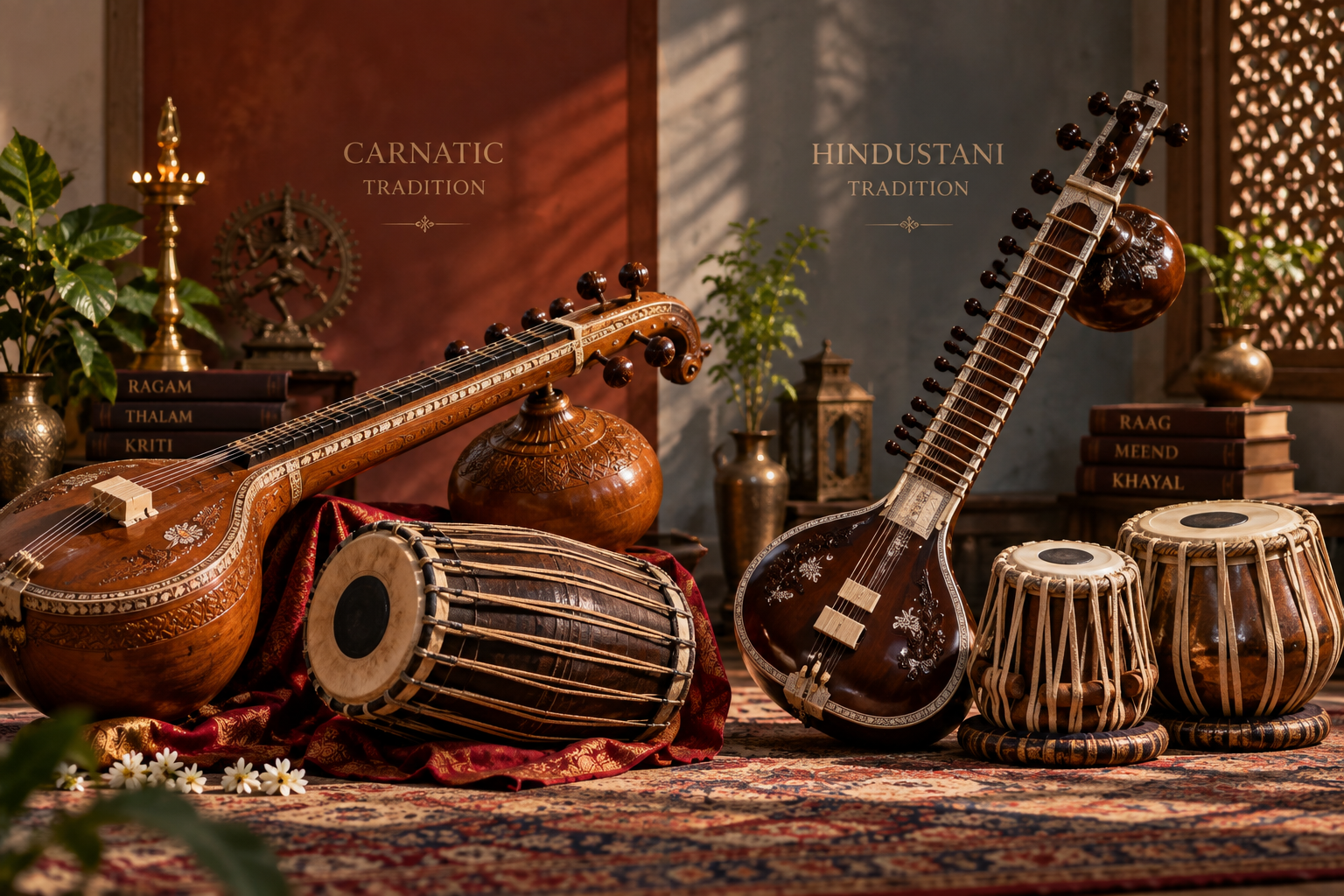
Veena and mridangam meet sitar and tabla in a visual guide to each tradition's signature instruments.
The violin in Carnatic music came from the West and was fully adopted. It is played sitting down, with the scroll resting on the foot.
7. How it is passed down
Hindustani music has gharanas, schools of style linked to families or lineages, including Gwalior, Kirana, Jaipur-Atrauli, Agra and Patiala. Your gharana shapes how you sing.
Carnatic music has strong teacher lineages too, but its learning path is more standardised. Almost every student begins with sarali varisai, janta varisai, alankarams, geethams and then varnams.
Quick summary
| Aspect | Carnatic | Hindustani |
|---|---|---|
| Region | South India | North India |
| Focus | Composition | Improvisation |
| Raga system | 72 Melakartas | 10 Thaats |
| Ornamentation | Heavy gamakas | Meend and steady notes |
| Concert structure | Many songs | Few ragas, deeply explored |
| Learning path | Highly structured | Gharana-based |
03 / Starting out
So, which one is easier?
Neither is easy. Both take years to master. But the beginner experience feels different.
- Carnatic can feel easier to start because the syllabus is clear. You know what lesson comes next and may sing compositions within months. The challenge comes later with gamakas and rhythm.
- Hindustani can feel slower at first because it asks you to sit with a single note, practise riyaz and build voice control before anything flashy. Many learners find it more intuitive once the ear develops.
“Easier” depends on whether you prefer a clear roadmap or a slow, open-ended exploration.
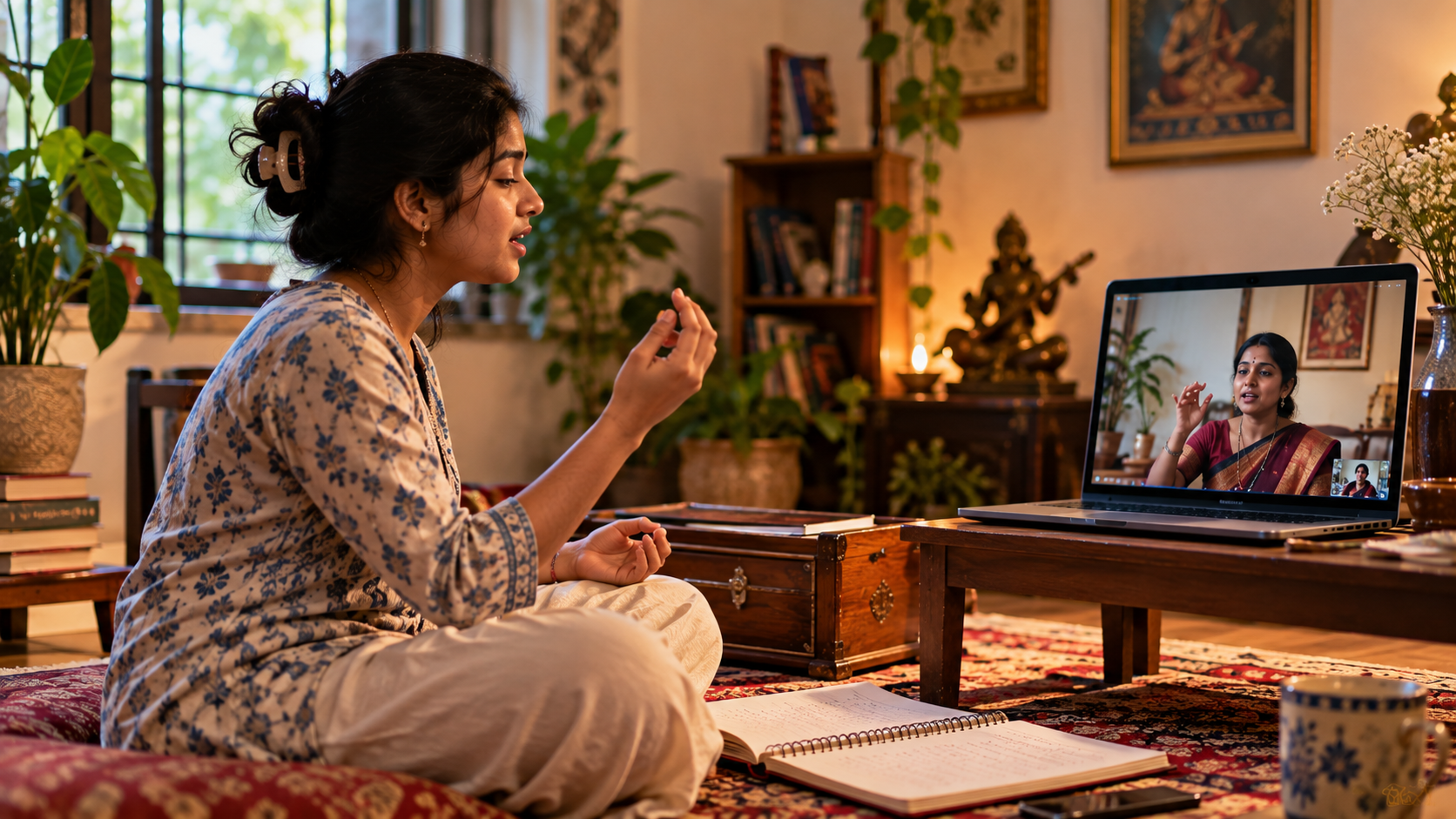
Live feedback brings the focus and responsiveness of a music lesson into the learner's home.
04 / Your path
How to choose: a simple guide
- You enjoy structure and clear milestones
- Compositions and rhythmic detail excite you
- South Indian musical traditions feel familiar
- You enjoy slow, immersive exploration
- Improvisation and melodic space excite you
- Ghazal, Sufi or North Indian sounds move you
- What music already moves you? If M.S. Subbulakshmi, Bombay Jayashri or the classical phrases in Ilaiyaraaja and A.R. Rahman's Tamil songs feel like home, explore Carnatic. If Bhimsen Joshi, Kishori Amonkar, Arijit Singh's semi-classical moments or old Bollywood ghazals give you goosebumps, lean Hindustani.
- What is your end goal? Carnatic training is valuable for Tamil, Telugu, Kannada or Malayalam film music. Hindustani fits naturally with Bollywood playback, ghazals and Sufi music. For fusion, indie music or composing, either gives you a powerful foundation.
- Do you prefer structure or freedom? If you love checklists and clear progress, Carnatic may suit you. If you love exploration and taking your time, Hindustani may feel natural.
- Which instrument draws you in? Veena or mridangam points towards Carnatic. Sitar, sarod or tabla points towards Hindustani. Flute, violin and vocals work beautifully in both.
- Can you find a good teacher? A great guru in either tradition will take you further than an average one in your preferred style. Live online classes have made both accessible from anywhere.
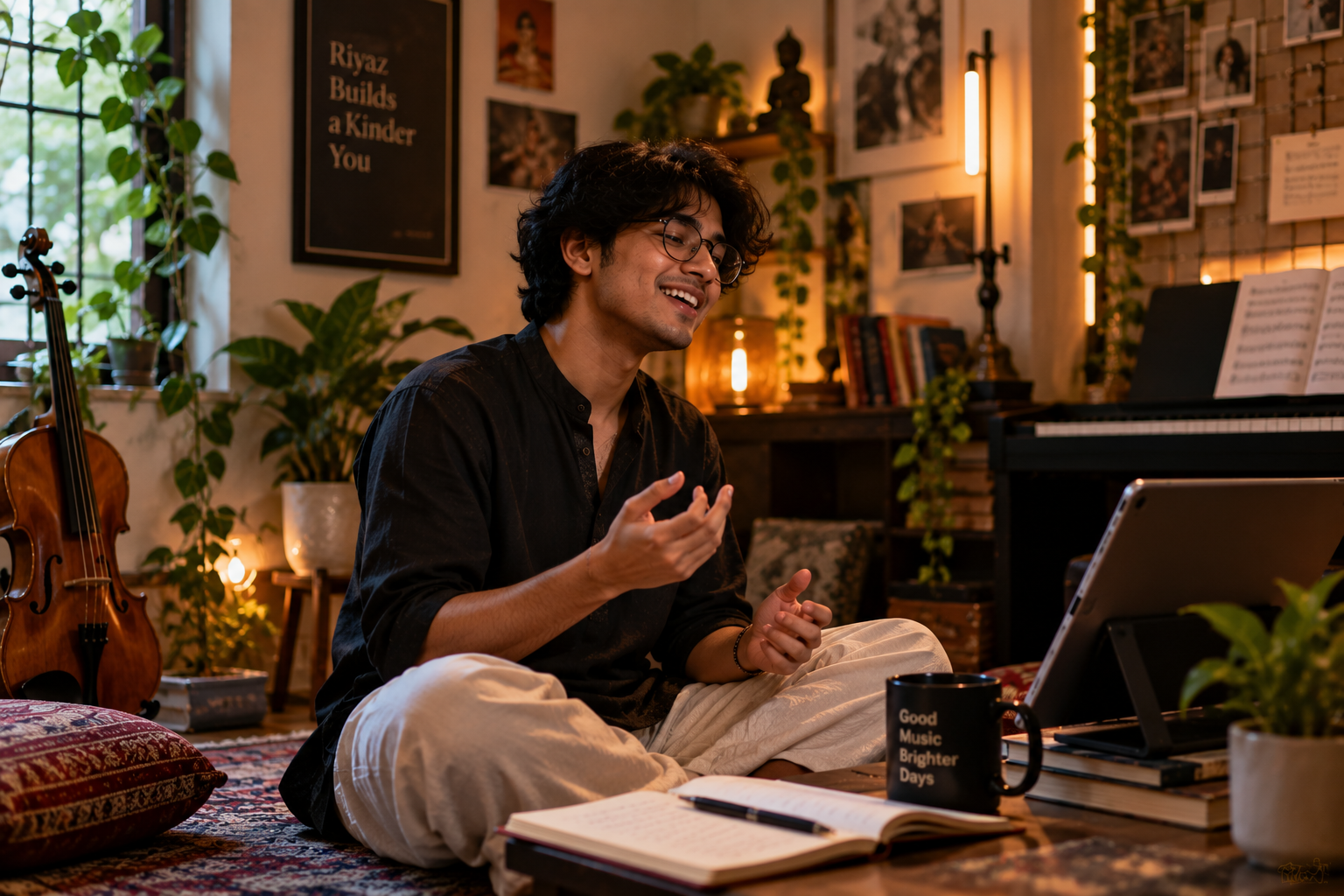
The right path is the one that keeps you curious, expressive and excited to practise.
05 / The takeaway
Can you learn both?
Yes, and many musicians do. But the practical advice is to start with one. The ornamentation and voice techniques are different enough that learning both from day one can confuse your ear. Build a strong base in one for a couple of years, then explore the other. You will understand both better that way.
The final word
The Carnatic vs Hindustani debate will probably never end at family dinners. That is fine, because it was never really a competition. They are two beautiful ways of answering the same question: how do you turn a raga into emotion?
Pick the one that makes your heart race a little faster. That is the right one.
Carnatic places compositions and intricate rhythm at the centre.
Hindustani gives improvisation and gradual melodic development more space.
Your listening taste, learning style, goal and teacher matter more than choosing the “easier” tradition.
Try before you decide
Not sure where to start?
Book a free trial with a trained SURIX mentor and experience Carnatic or Hindustani music for yourself.
06 / FAQs
Frequently asked questions
What is the main difference between Carnatic and Hindustani music?
Carnatic music is composition-centred and known for heavy gamakas, while Hindustani music is improvisation-centred and builds each raga slowly through alaap.
Which is older, Carnatic or Hindustani music?
Neither. Both come from the same ancient roots and began developing separately around the 13th to 16th centuries.
Is Carnatic music harder than Hindustani?
Not necessarily. Carnatic has a clearer beginner syllabus, while Hindustani asks for more patience early on. Difficulty depends on your learning style.
Can I learn Carnatic or Hindustani music online?
Yes. With a live teacher who can correct your pitch and ornamentation in real time, online learning works very well for both styles.
At what age should I start learning classical music?
There is no age limit. Children can start early, but many learners begin in their teens, twenties or later and progress well with consistent practice.