
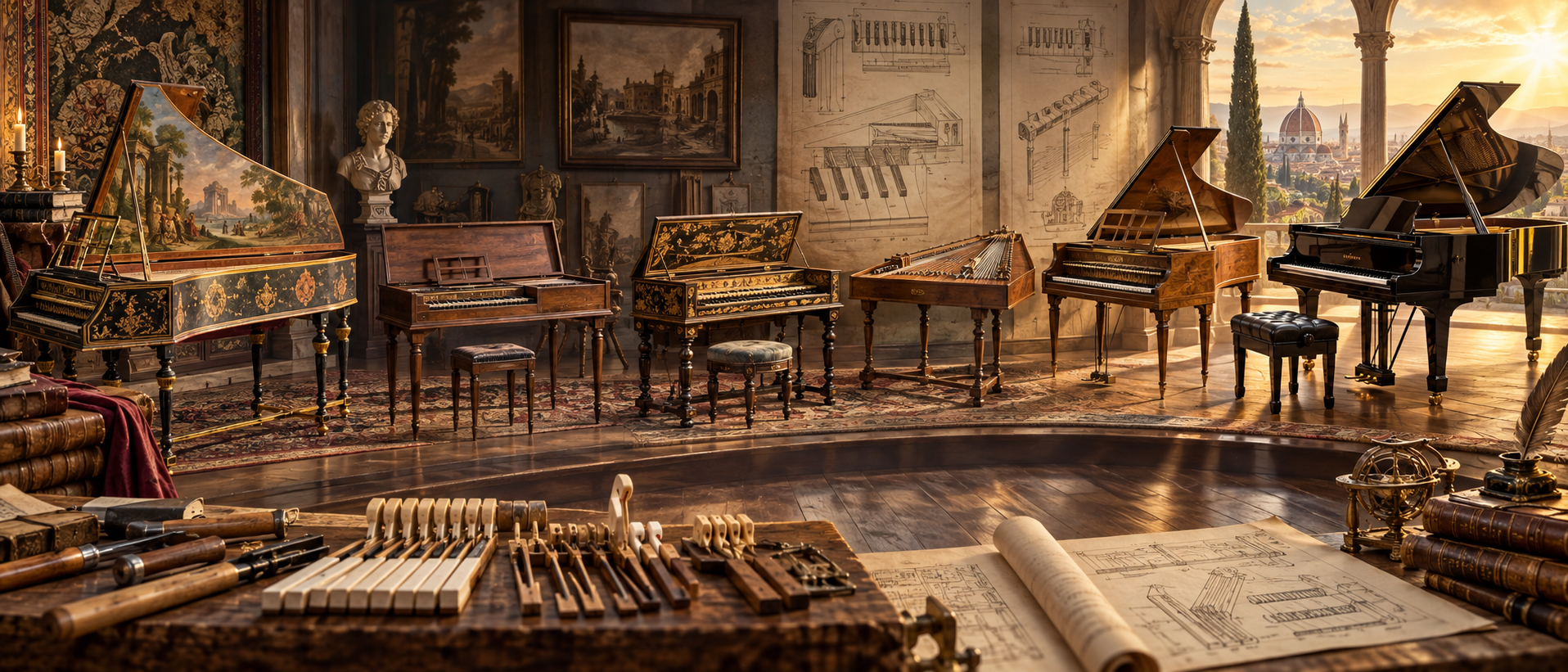
The piano was invented by Bartolomeo Cristofori, an Italian instrument maker from Padua, around 1700 in Florence, while he worked for Prince Ferdinando de’ Medici. Before the piano, people played keyboard instruments like the harpsichord, the clavichord and the organ, whose earliest ancestor, the water-powered hydraulis, dates back to the 3rd century BC.
Try this the next time you sit at a piano or keyboard.
Press a key gently. You get a soft note. Now hit the same key hard. Loud note.
A whisper you can barely hear across the room.
Thunder that fills a hall. Same key, your choice.
Feels like the most obvious thing in the world, right? Except for most of history, that was not true. For hundreds of years, keyboard players could press as softly or as hard as they wanted, and the instrument gave them the exact same volume every single time. No whisper. No thunder. Just one flat level.
The piano exists because one man in Italy got tired of that. But he did not start from zero — he was standing on nearly 2,000 years of keyboard history. So let us rewind.
01 / The missing ingredient
The problem the piano solved
Before we meet the piano’s ancestors, you need to understand the one thing every musician before 1700 was missing: dynamics, the ability to play soft and loud.
Singers had it. Violinists had it. Flute players had it. But keyboard players were stuck choosing between two imperfect instruments. One could play loud but not soft. The other could play soft but barely loud enough to hear across a room.
02 / The family tree
The instruments that came before the piano
The great-great-grandparent
The Hydraulis
Our story starts not in Europe, but in Alexandria, Egypt. Around the 3rd century BC, a Greek engineer named Ctesibius built the hydraulis, a water organ. It used water pressure to push air steadily through pipes, and it had a set of keys to control which pipes sounded. Historians widely consider it the world’s first keyboard instrument.
The hydraulis became a hit across the Roman world, playing at festivals and even gladiator games. Over the centuries, water was replaced by bellows, and the hydraulis slowly evolved into the pipe organ you see in churches today.
For well over a thousand years, the organ was the only keyboard instrument in existence. Powerful? Yes. Portable? Absolutely not. And it could not respond to your touch.
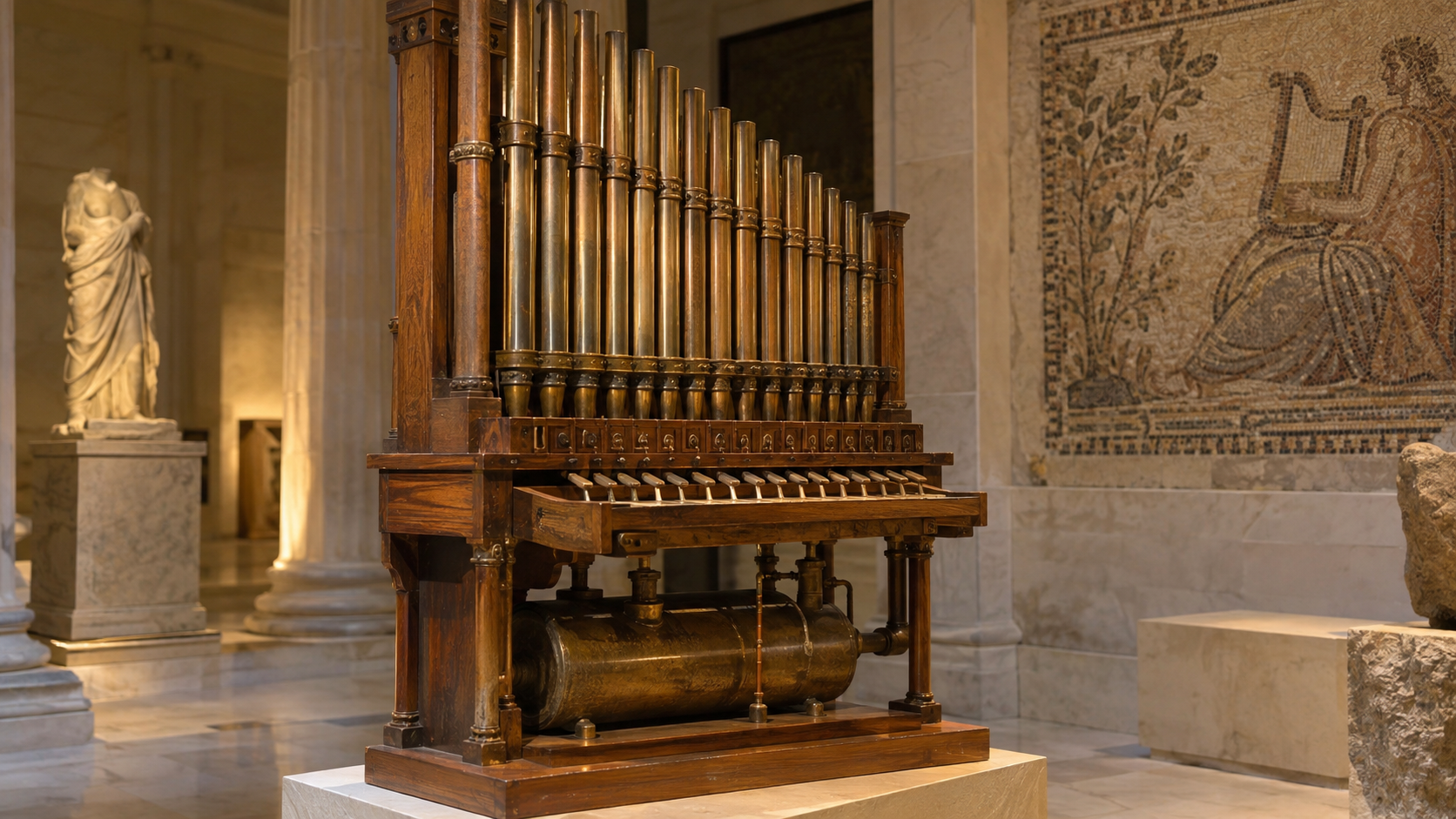
An ancient Greek or Roman water organ — a museum reconstruction, mosaic or historical engraving.
The string cousins
The Psaltery and the Dulcimer
While organs were blowing air, another family of instruments was doing something different: vibrating strings stretched over a wooden box.
The psaltery was a medieval instrument whose metal strings were plucked by hand. Its sibling, the hammered dulcimer, was played by striking the strings with small hammers. If that sounds familiar, it should — our own santoor belongs to the same hammered dulcimer family.
Hold on to that idea of hammers hitting strings. It becomes very important later.
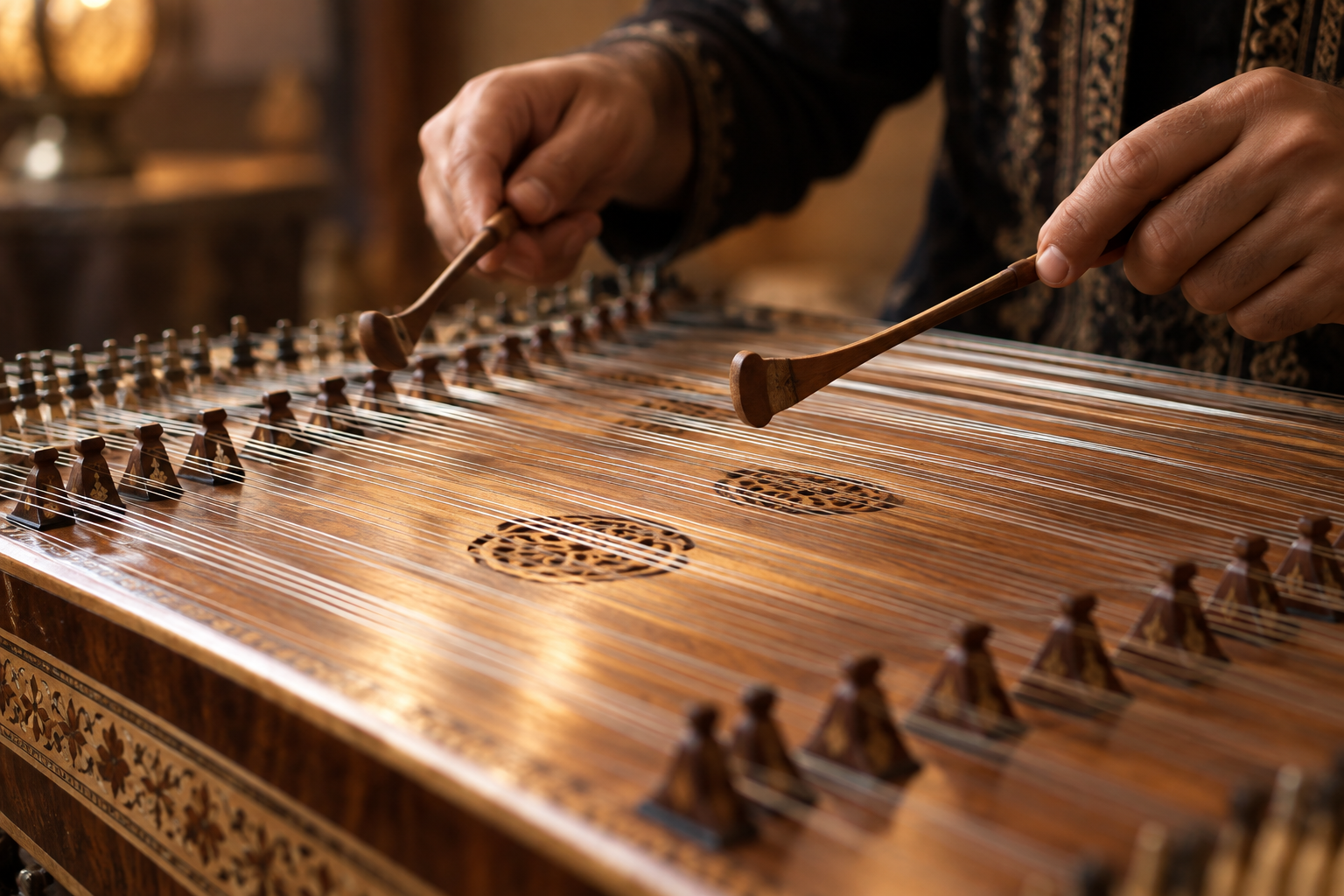
A hammered dulcimer or Indian santoor, close up on the strings and the small wooden hammers.
The quiet genius
The Clavichord
Somewhere in the late Middle Ages, someone had a brilliant idea: what if we attached a keyboard to strings? The clavichord was one of the results, likely invented in the 14th century, with a German poem from 1404 generally considered its first clear mention.
When you pressed a key, a small metal blade called a tangent struck the string and stayed pressed against it. Because your finger was directly connected to the string, the clavichord actually responded to touch. Softer press, softer note.
Sounds perfect, right? The catch: it was incredibly quiet. Fine for practising alone in your room. Useless for a concert hall, or even a dinner party.
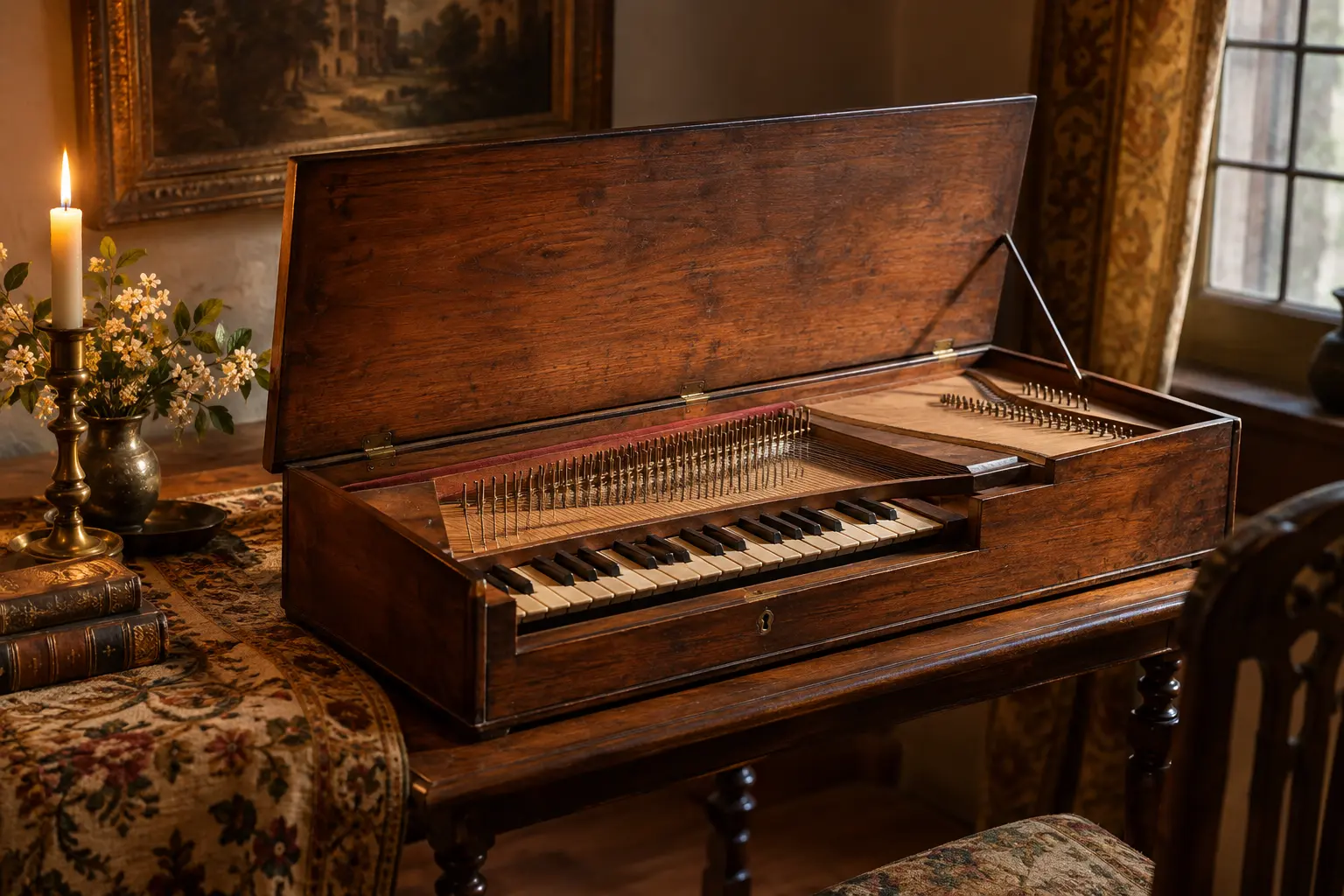
A clavichord with its lid open, in a warm, candlelit room.
The loud one
The Harpsichord
The earliest known reference to the harpsichord comes from 1397 in Padua, Italy, where a legal writer noted that a man named Hermann Poll claimed to have invented an instrument called the clavicembalum. The oldest complete harpsichords that survive today come from Italy, the earliest dated 1521.
Instead of striking the strings, the harpsichord plucked them using a small quill. That made it much louder and brighter than the clavichord — perfect for royal courts, churches and ensembles.
But plucking has a limitation. No matter how you press the key, the quill plucks with the same force, so every note comes out at the same volume. Baroque composers worked around this with clever writing and multiple keyboards, but the fundamental problem remained.
The harpsichord also had smaller relatives: the virginal, the spinet and the upright clavicytherium. A clavicytherium made around 1480, now at the Royal College of Music in London, is often described as the oldest surviving stringed keyboard instrument in the world.
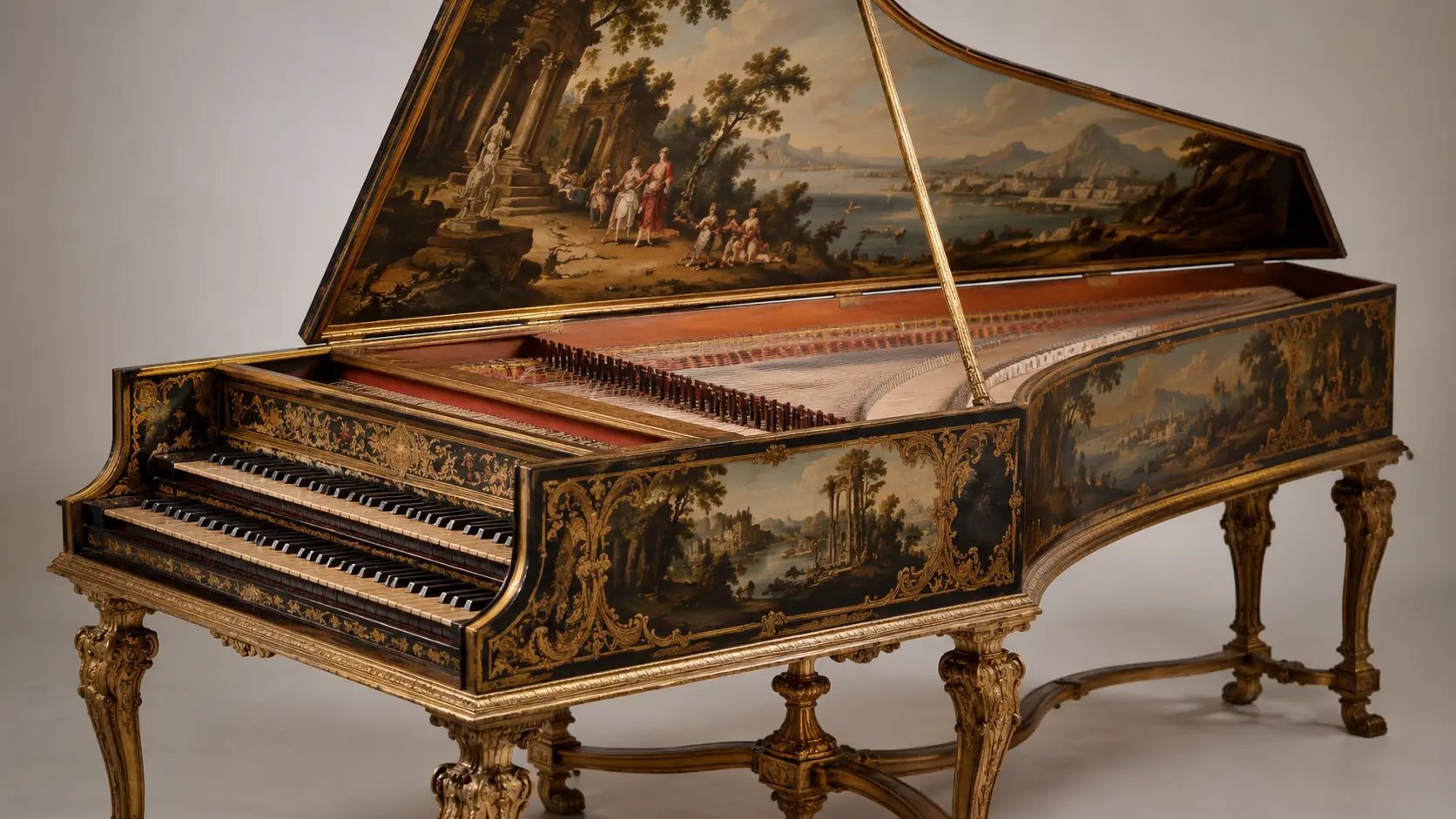
An ornate Italian harpsichord, ideally with the plucking quills or jacks visible inside.
The piano that almost was
The Dulce Melos
Here is a fun twist most history articles skip. In the mid-1400s, a scholar named Henri Arnaut de Zwolle described an instrument called the dulce melos, a keyboard that struck its strings rather than plucking them. Some historians call it an early piano.
So why did it not take over the world? It never caught on, and the technology to control a hammer precisely — so that it hit the string and bounced away cleanly — simply did not exist yet. The idea was right. The engineering was not ready.
It would take another 250 years and one very patient Italian to fix that.
03 / Head to head
Clavichord vs harpsichord vs piano
| Clavichord | Harpsichord | Piano | |
|---|---|---|---|
| How sound is made | Metal tangent strikes and holds the string | Quill plucks the string | Felt hammer strikes and bounces off the string |
| Soft and loud? | Yes, but only within a very quiet range | No, one fixed volume | Yes, full range from very soft to very loud |
| Volume overall | Very quiet | Loud and bright | Loud and rich |
| Best for | Private practice | Courts, churches, ensembles | Almost everything |
04 / The breakthrough
Enter Bartolomeo Cristofori
Bartolomeo Cristofori was born in 1655 in Padua — the same city where the harpsichord was first mentioned about 250 years earlier. History loves a callback.
In 1688, he joined the court of Grand Prince Ferdinando de’ Medici in Florence, a passionate music lover and harpsichord player who owned a huge collection of instruments. Cristofori’s job was to look after them, repair them and build new ones. Somewhere along the way, he set himself a challenge: build a keyboard as loud as a harpsichord but as expressive as a clavichord.
The first clear evidence of the piano comes from a 1700 inventory of the Medici instrument collection. It lists an arpicembalo by Cristofori, described as a new invention that could play piano and forte, soft and loud.
His genius was the hammer mechanism
Lets the hammer strike the string and immediately fall away, so the string keeps vibrating freely.
Catches the hammer so it does not bounce back and hit the string twice.
Silence the string the moment you let go of the key.
This is exactly the problem the dulce melos could not solve centuries earlier. The basic idea behind Cristofori’s action still lives inside every acoustic piano today.
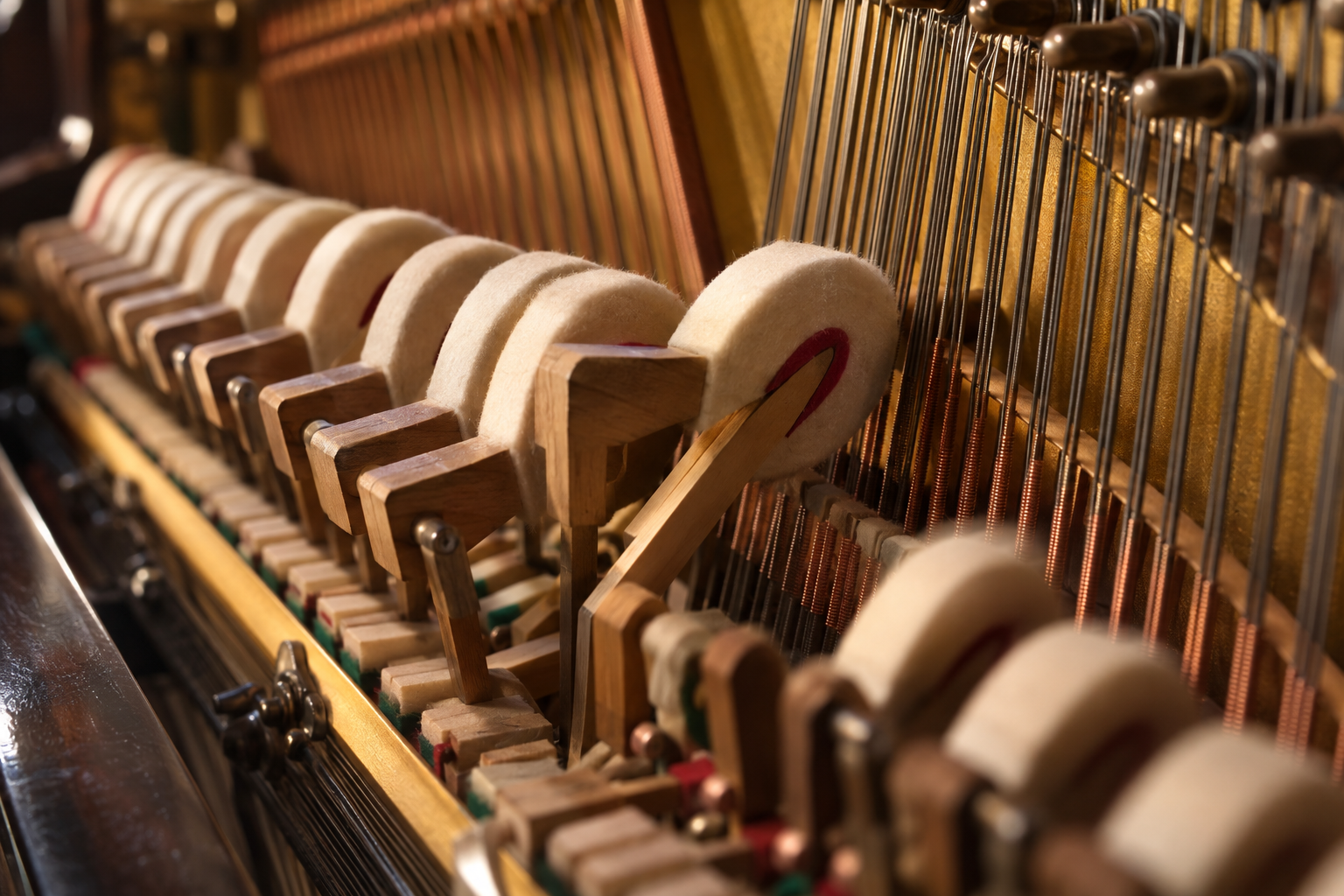
A close-up inside a piano showing felt hammers striking the strings.
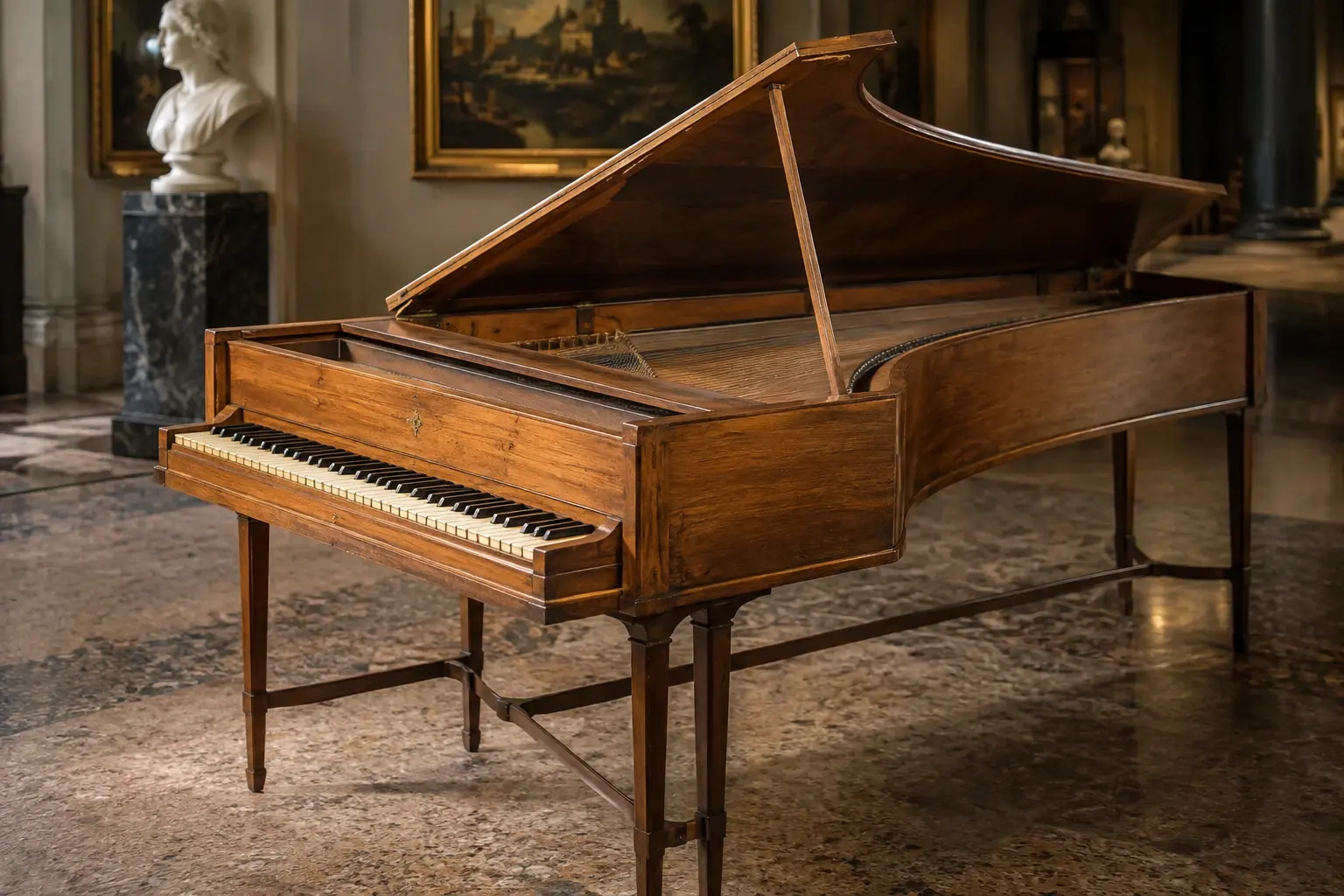
The 1720 Cristofori piano at the Met (public domain) or a period fortepiano.
05 / The name
How the piano got its name
In 1711, the poet and journalist Scipione Maffei wrote about the invention and called it a gravicembalo col piano e forte — roughly, “harpsichord with soft and loud”.
So every time you say “piano”, you are literally saying “soft”. Slightly ironic for an instrument that can fill a stadium.
06 / Survivors
The oldest piano in the world
Only three Cristofori pianos survive today.
The Metropolitan Museum of Art
The oldest surviving piano in the world.Museo Nazionale degli Strumenti Musicali
One of only three Cristofori pianos left anywhere.Musical Instrument Museum, Leipzig University
Built five years before Cristofori died in 1731.Cristofori died in 1731, just as his invention was starting to catch on. He never saw how big it would become.
07 / Growing up
From Cristofori to your living room
The piano did not become the piano overnight. Here is how it grew up.
The German chapter
Organ builder Gottfried Silbermann began making pianos based on Cristofori’s design. Johann Sebastian Bach reportedly criticised an early Silbermann piano for its heavy touch and weak high notes, but later approved the improved versions.
The Mozart and Beethoven era
The fortepiano, lighter and smaller than today’s instrument, became the star of classical music. As composers demanded more power and range, builders kept pushing the design further.
The speed upgrade
In Paris, Sébastien Érard patented the double escapement action, letting a note be repeated quickly without the key fully rising. Virtuosos like Franz Liszt made the most of it, and it became the grand-piano standard.
The iron age
In Boston, Alpheus Babcock patented a one-piece cast iron frame, allowing thicker, tighter strings. In a modern grand, total string tension can approach 20 tonnes. Wood alone could never hold that.
Softer hammers
Parisian maker Jean-Henri Pape introduced felt-covered hammers, giving the piano its warm, rounded tone. Felt hammers are still used today.
The modern piano
With iron frames, felt hammers, better actions and cross-stringing, the piano settled into the form we know, with 88 keys eventually becoming standard.
08 / At a glance
The piano timeline
Scroll across to travel through 2,000 years.
Ctesibius builds the hydraulis in Alexandria, the first keyboard instrument
First known reference to the harpsichord, in Padua
First clear written mention of the clavichord
Henri Arnaut de Zwolle describes the dulce melos, a struck-string keyboard
Oldest surviving stringed keyboard instrument, a clavicytherium
Cristofori’s piano appears in the Medici inventory in Florence
Scipione Maffei names it the “gravicembalo col piano e forte”
Oldest surviving piano built, now at the Met in New York
Gottfried Silbermann starts building pianos in Germany
Sébastien Érard patents the double escapement action
Alpheus Babcock patents the cast iron frame
Jean-Henri Pape introduces felt hammers
The modern 88-key piano becomes standard
09 / Closer to home
Meanwhile, in India: the keyboard we made our own
Pianos arrived in India with Europeans during the colonial era and found homes in churches, clubs and wealthy households. But the keyboard instrument that truly became Indian was a different one: the harmonium.
The harmonium was invented in Europe, but its original version was a large instrument pumped with the feet. That did not suit Indian musicians, who traditionally performed sitting on the floor. So in 1875, Dwarkanath Ghose of Dwarkin in Kolkata introduced a hand-pumped harmonium. It was smaller, cheaper, easier to repair, and could be played sitting on the ground. Drone stops were added to suit Indian music.
The result? The harmonium became one of the most familiar sounds in Indian music, from Hindustani vocal concerts and bhajans to qawwali and Sikh kirtan. And today, digital keyboards and synths sit at the heart of Indian film music, from Ilaiyaraaja’s orchestration to A.R. Rahman’s studio experiments.
Different path, same dream: a keyboard that could carry emotion.
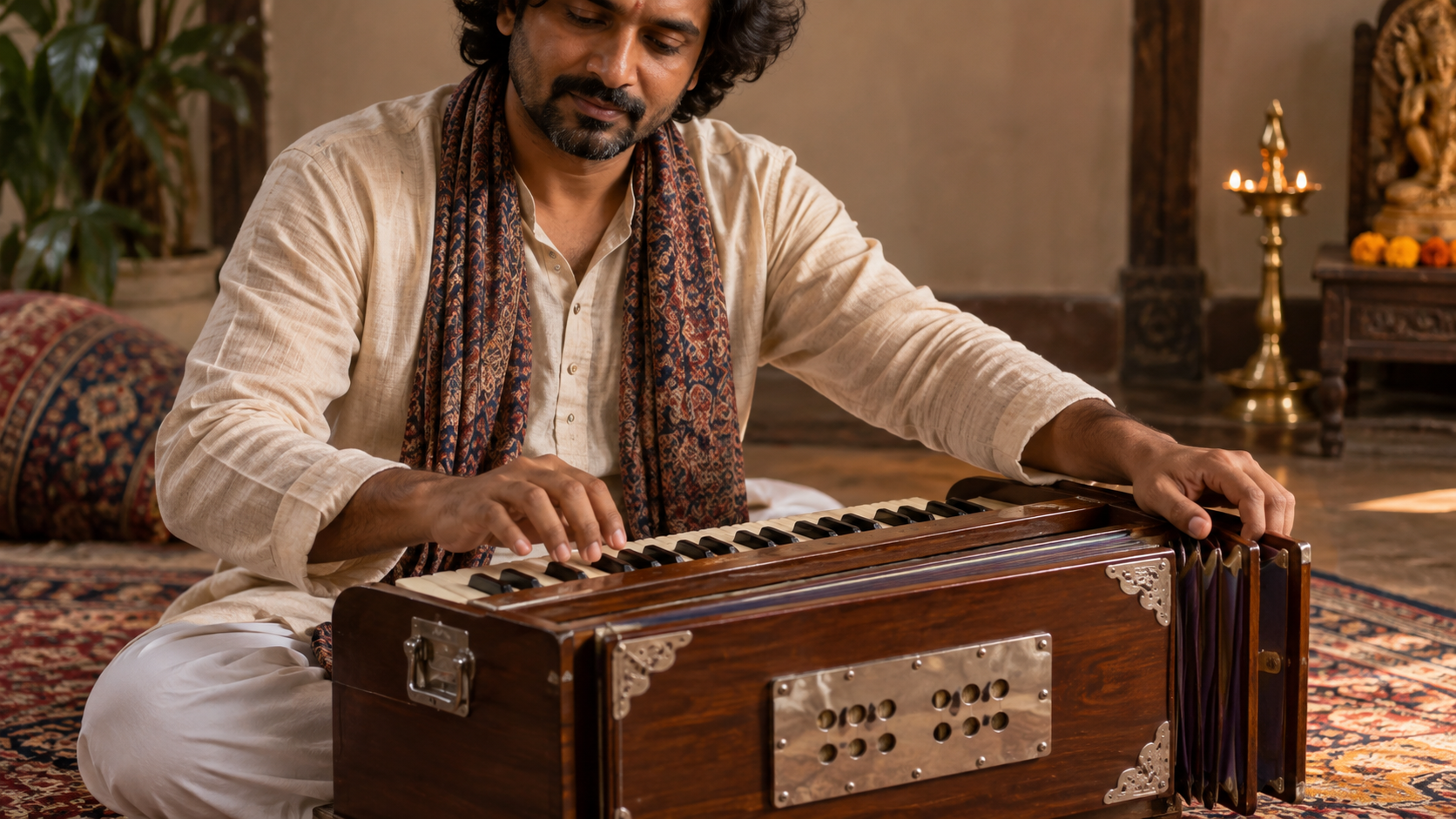
A harmonium being played seated on the floor, or a modern Indian studio keyboard setup.
10 / Why it matters
Why this history matters when you learn piano
Every time you practise playing softly and loudly on a piano, you are using the exact thing that took humanity 2,000 years to figure out. That is why good piano teachers obsess over touch and dynamics from the very first lessons. The notes are only half the music. How you play them is the other half.
When your teacher asks you to play a phrase “more softly” for the tenth time, remember: Cristofori spent years in a Florentine workshop so you could.
Feel it under your own fingers
Ready to play soft and loud on purpose?
Book a free 1:1 trial and start learning piano or keyboard with a trained SURIX mentor.
11 / FAQs
Frequently asked questions
Who invented the piano?
Bartolomeo Cristofori, an Italian instrument maker from Padua, invented the piano around 1700 while working for Prince Ferdinando de’ Medici in Florence.
When was the piano invented?
The piano was invented around 1700. The earliest clear evidence is a 1700 inventory of the Medici family’s instrument collection.
What instrument came before the piano?
The harpsichord and the clavichord were the main keyboard instruments before the piano. The organ is even older, with roots in the hydraulis, an ancient water organ from the 3rd century BC.
What is the difference between a harpsichord and a piano?
A harpsichord plucks its strings with a quill, so every note has the same volume. A piano strikes its strings with felt hammers, so the player controls how soft or loud each note sounds.
What is the oldest piano in the world?
The oldest surviving piano is a 1720 instrument by Bartolomeo Cristofori, displayed at the Metropolitan Museum of Art in New York.
Why is it called a piano?
It comes from the Italian pianoforte, meaning “soft-loud”, because it was the first keyboard that could play both soft and loud notes depending on the player’s touch.
What was the first keyboard instrument?
The hydraulis, a water organ built by the Greek engineer Ctesibius in Alexandria in the 3rd century BC, is widely considered the first keyboard instrument.
Is the harmonium an Indian instrument?
The harmonium was invented in Europe, but the hand-pumped version used across India was developed in Kolkata by Dwarkanath Ghose in 1875, adapted for musicians who play sitting on the floor.
12 / Sources
Research and references
- The Metropolitan Museum of Art — The Pianofortes of Bartolomeo Cristofori
- Bartolomeo Cristofori — Wikipedia
- Artnet News — The World’s Oldest Known Piano Is at the Met
- History of the harpsichord — Wikipedia
- Clavichord — Wikipedia
- Clavicymbalum and the dulce melos — Wikipedia
- Cambridge University Press — A History of Stringed Keyboard Instruments
- European Cultural Centre of Delphi — Hydraulis reconstruction
- Keyboard instrument — Wikipedia
- Sébastien Érard — Wikipedia
- Alpheus Babcock — Wikipedia
- New World Encyclopedia — Piano
- Scroll.in — The harmonium was born in Europe